Thai baht: Thailand's currency, banknotes and coins 2026
What Thailand’s money is called, what THB means, which notes and coins circulate in 2026, the new polymer 50 and 100 baht notes and how to spot fakes.
Updated: 2026-10-10 · 7 min read · AURA Phuket
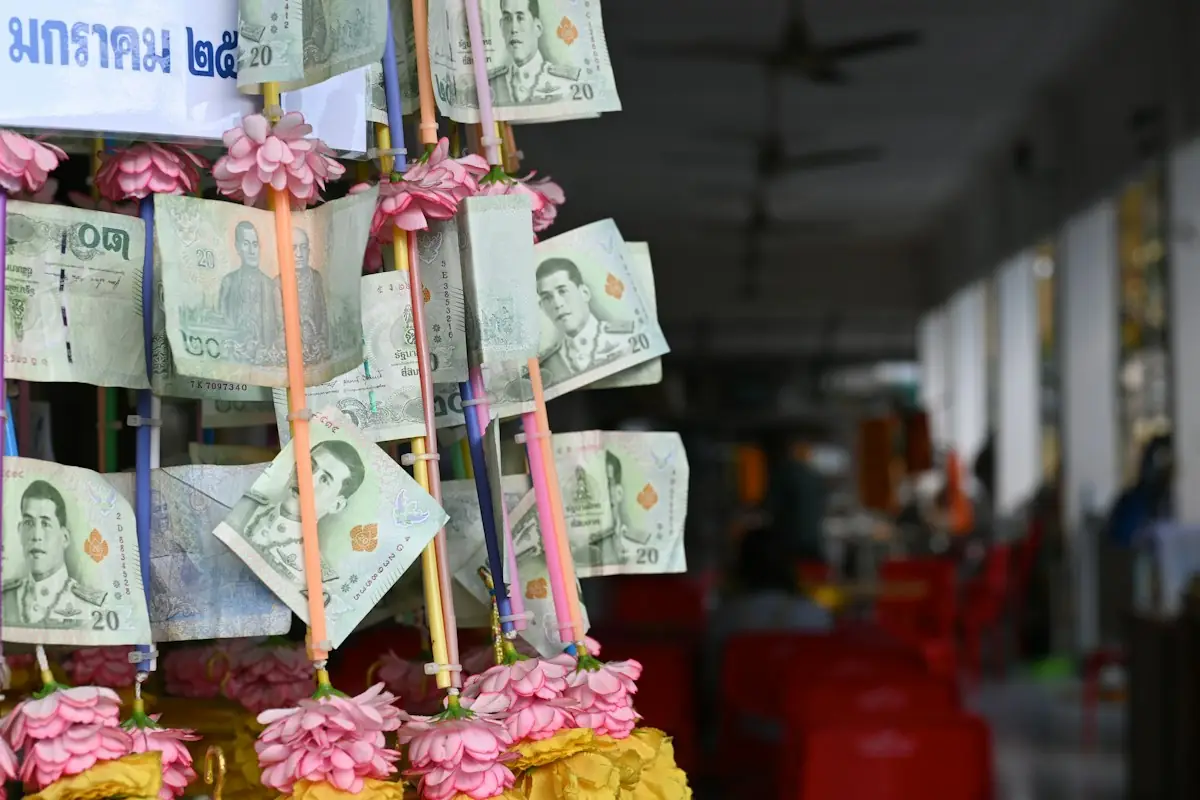
Thailand’s money is the Thai baht: three-letter code THB, symbol ฿, and one baht is divided into 100 satang. As of October 2026, the notes in circulation are 20, 50, 100, 500 and 1,000 baht, and the coins are 25 and 50 satang plus 1, 2, 5 and 10 baht. Current notes carry a portrait of King Rama X, but notes showing King Rama IX are still legal tender.
Key facts
- Currency: Thai baht, ISO 4217 code THB, symbol ฿, written บาท in Thai; 1 baht = 100 satang.
- Notes: 20 (green), 50 (blue), 100 (red), 500 (purple) and 1,000 baht (brown).
- Coins in use: 25 and 50 satang, 1, 2, 5 and 10 baht; the 10 baht coin is two-tone bimetallic.
- The polymer 20 baht note came out on 24 March 2022, polymer 50 and 100 baht notes on 21 November 2025 (Bank of Thailand).
- Paper notes of the current and earlier series stay in circulation alongside the polymer ones.
- The Bank of Thailand suggests a three-step authenticity check: feel, look against the light, tilt.
What Thai money is called: baht, THB and ฿
The official name is the Thai baht, บาท in Thai. Banks, booking sites and exchange offices use the code THB, the ISO 4217 standard and the three letters people search for. Shops and menus show prices with the ฿ sign or just a number, and supermarket price tags often read something like 100.-, which simply means 100 baht.
The smaller unit is the satang (สตางค์), one hundredth of a baht. In daily life you only meet satang as 25 and 50 coins, mostly in change at chain stores. The word baht originally meant a weight of silver, and Thai gold shops still use it as a weight unit: one baht of gold is about 15.2 grams.
Thai baht banknotes and what they look like
The current Series 17 notes have been issued since 2018. According to the Bank of Thailand, every denomination shows King Maha Vajiralongkorn (Rama X) in Air Force uniform on the front, and two kings of the Chakri dynasty in order of reign on the back. Colours and sizes match the previous series, so you can tell notes apart by colour and length: the higher the value, the longer the note.
| Note | Colour | Size, mm | Kings on the back (Series 17) |
|---|---|---|---|
| 20 ฿ | Green | 72 × 138 | Rama I and Rama II |
| 50 ฿ | Blue | 72 × 144 | Rama III and Rama IV |
| 100 ฿ | Red | 72 × 150 | Rama V and Rama VI |
| 500 ฿ | Purple | 72 × 156 | Rama VII and Rama VIII |
| 1,000 ฿ | Brown | 72 × 162 | Rama IX and Rama X |
Now and then commemorative notes turn up in change, for example the 100 baht note marking 150 years of the Ministry of Finance (2025). They are legal money too, so you can spend them or swap them at a bank; only the design differs from the usual one.
Polymer 20, 50 and 100 baht notes
Thailand is gradually moving its most-used denominations to polymer. The polymer 20 baht arrived on 24 March 2022, and on 21 November 2025 the Bank of Thailand issued polymer 50 and 100 baht notes. They keep the look of the paper notes but add a clear window with an embossed value, visible from both sides. The Bank of Thailand estimates polymer lasts about four times longer than paper, roughly eight years.
- Paper and polymer notes of the same value are equal, and shops accept both.
- ATMs dispense the polymer 100 baht too, and vending machines take both new notes.
- Polymer is slippery and does not hold a fold, so count a stack carefully as notes stick together.
- Keep polymer notes away from strong heat, such as a car dashboard in the sun.
Thai coins: which ones exist and where you need them
Six coins are in everyday use. The most useful are 10, 5 and 1 baht: you need them for public toilets, coin laundries, vending machines and small market purchases. Satang coins mostly come back as change at 7-Eleven and supermarkets, where prices can include fractions.
| Coin | What it looks like | Where it helps |
|---|---|---|
| 25 and 50 satang | Small, gold-coloured | Change at chain stores |
| 1 ฿ | Silver, small | Vending machines, change |
| 2 ฿ | Gold-coloured (older issues silver) | Small purchases |
| 5 ฿ | Silver, copper visible on the edge | Toilets, laundries |
| 10 ฿ | Silver ring, gold centre | Tips, markets, machines |
The usual mix-up is the old silver 2 baht coin minted in 2005 to 2007, which looks a lot like 1 baht. Read the number, not the colour. Coins of 1, 5 and 10 satang technically exist, but you will hardly ever see them in normal use.
Rama IX and Rama X notes: both are valid
Until 2018 Thai money carried a portrait of King Bhumibol Adulyadej (Rama IX). Those notes were never withdrawn: the Bank of Thailand states that the current and previous series remain legal tender, and worn notes can be exchanged at commercial banks. So one bundle of change can easily include both King Bhumibol and King Vajiralongkorn. If a vendor refuses an older note, ask politely to pay with another or change it at a bank; it does not mean the note is fake.
How to check that baht notes are genuine
The Bank of Thailand recommends a simple routine: feel, look, tilt. The features below apply to Series 17 paper notes; on polymer notes the main check is the clear window with its embossed number.
- Feel: cotton-based paper, firmer than ordinary paper; the emblem, the words รัฐบาลไทย and the value are printed in raised ink you can feel.
- Against the light: a watermark with the King’s portrait and the value, a metallic security thread with numerals, and front and back designs that line up.
- A hidden value numeral in the lower left corner appears when you view the note at a sharp angle.
- Tilt: on the 500 and 1,000 baht notes, the ornament with the value shifts from gold to green.
- If you doubt a note, do not argue with the vendor; take it to any bank branch.
The best protection against fakes is to change money at banks and licensed exchange offices, not with strangers. Common schemes are covered in a separate article.
Currency exchange scams in Thailand — how to avoid them
Etiquette: the King’s image on money
Every note and coin bears the King’s image, and the monarchy in Thailand is treated with deep respect that is also protected by law (Section 112 of the Criminal Code on insulting the monarchy). In practice that comes down to a few simple rules.
- Never step on money: if a coin or note rolls away, pick it up by hand rather than stopping it with your foot.
- Do not tear, draw on or burn notes, even as a joke or for the camera.
- Do not toss money at a vendor; hand it over or place it on the payment tray.
Where you need small notes and how to get them
ATMs dispense mostly 1,000 baht notes, which are awkward on Phuket: taxi drivers, tuk-tuks, street-food stalls and beach massage staff often cannot change a large note. Keep 20, 50 and 100 baht notes and a handful of 10 baht coins in a separate pocket.
- Break 1,000 baht notes at 7-Eleven, FamilyMart and supermarkets while buying water or a snack.
- At an exchange office, ask for part of the amount in 100 baht notes straight away.
- Small change covers tips, temple donations, public toilets and laundries.
- Before a trip to the islands or a national park, carry small notes: change can be hard to find there.
If you need cash without visiting an exchange office, a licensed exchange service can provide baht as a cardless ATM withdrawal, courier delivery to your hotel or a transfer to a Thai account.
Currency exchange in Phuket — baht by courier, ATM or transfer — 1 option
Frequently asked questions
What is the money in Thailand called?
The Thai baht (บาท in Thai), symbol ฿. One baht is divided into 100 satang.
What are the three letters for Thai money?
THB, the international ISO 4217 code for the Thai baht. Banks, exchange offices and booking sites use it.
What do baht notes look like and which exist?
Notes of 20 (green), 50 (blue), 100 (red), 500 (purple) and 1,000 baht (brown), with the King’s portrait on the front. Higher values are longer, and 20, 50 and 100 baht also come in polymer.
What coins does Thailand use?
25 and 50 satang, plus 1, 2, 5 and 10 baht. The 10 baht coin is two-tone, and older 2 baht coins are silver and look like 1 baht, so check the number.
Are notes with the late King still valid?
Yes. Notes showing King Bhumibol (Rama IX) remain legal tender, and worn notes can be exchanged at any commercial bank.
Can I change Thai coins back before leaving?
Exchange offices usually buy back notes only and rarely accept coins. Spend the change at the airport or leave it as tips.
Need baht in handy notes on arrival or mid-holiday? Send a request in the currency exchange section: the partner’s manager confirms the amount, and you pay only after confirmation.