Tipping in Thailand: how much to leave, plus etiquette
Tipping in Thailand: how much to leave at restaurants, for massage and guides, what ‘++’ means, and etiquette for temples, monks and markets.
Updated: 2026-10-10 · 7 min read · AURA Phuket
Tipping in Thailand is a custom, not an obligation. In cafés people round up the bill or leave 20–100 baht, restaurants marked ‘++’ already add a 10% service charge, a masseur usually gets 50–100 baht per hour, and a guide on a group tour about 100 baht per person. Etiquette rests on three things: respect for the king, respect for Buddhism and a calm tone in any dispute.
Key facts
- ‘++’ on a menu means a 10% service charge and 7% VAT on top of the listed price.
- Tips are optional; a guide figure for massage is 50–100 baht per hour, and 20–50 baht per bag for a porter.
- Insulting the monarchy is a crime under Article 112: 3 to 15 years in prison per count.
- Women do not touch monks or hand them anything directly.
- At 8:00 and 18:00 the national anthem plays in public places, and people stop where they are.
- Since 29 May 2026 shops sell alcohol from 11:00 to midnight, and sales at ordinary outlets are banned on Buddhist holy days.
Tipping in Thailand: how much to leave
The first thing to check is the bill itself. In hotels, mid-range and upmarket restaurants and hotel bars, menu prices are often marked ‘++’: a 10% service charge is added, then 7% VAT on the resulting total. A 100-baht dish ends up costing 117.7 baht. If a service charge is included, anything extra is entirely up to you. You cannot see how a venue shares that charge among its staff, so if you want to thank a particular waiter, it is simpler to hand them cash in person. Street stalls and food courts do not expect tips, though leaving the small change is fine.
| Situation | Guide figure | Comment |
|---|---|---|
| Street food, food court | Not expected | Leave the small change if you like |
| Café with no service charge | 20–100 baht or round up | Depending on the service |
| Restaurant with ‘++’ | Extra is optional | 10% is already on the bill |
| Massage in a salon | 50–100 baht per hour | In person to the therapist, after the session |
| Upmarket spa | 100–300 baht | When the service is genuinely good |
| Hotel porter | 20–50 baht per bag | In small notes |
| Housekeeping | 20–50 baht per day | Left in the room with a note |
| Taxi, Grab, Bolt | Round up the fare | Optional |
| Guide on a group tour | About 100 baht per person | If they did a good job |
| Private boat crew | 500–1,000 baht per group | At the end of the day, to the captain or lead crew |
How to tip so it lands well
- Carry 20, 50 and 100-baht notes: asking for change from a thousand just to leave a tip is awkward for both sides.
- After a massage, hand the money to the therapist directly rather than at reception: the salon keeps a sizeable share of the session price.
- Money is passed with the right hand or both hands, never tossed onto the table.
- Thai notes and coins carry the king’s image. If a coin rolls away, do not stop it with your foot, and never step on money.
- A tip is a thank-you, not a way to hurry anyone. If the service was poor, you owe nothing.
Massage and spas in Phuket — catalogue — 1 option
The monarchy: a subject people do not discuss
The king and the royal family are deeply respected in Thailand, and Article 112 of the Criminal Code sets 3 to 15 years in prison per count for insulting the monarchy. The law applies to foreigners too, including posts and comments on social media. The practical takeaway is simple: no jokes about the royal family, no discussing it with locals, no defacing portraits or money. In cinemas the royal anthem usually plays before the film and the audience stands; at 8:00 and 18:00 the national anthem plays in parks, at stations and outside government buildings, and passers-by stand still for a minute. Do the same.
Temples and monks
- Dress: covered shoulders and knees. Large temples sometimes lend cover-ups, but do not count on it.
- Shoes come off at the door of buildings housing Buddha images; follow the signs and the pile of shoes at the entrance. Do not step on the threshold, and take off hats and sunglasses.
- When sitting before a Buddha image, tuck your legs so that your soles point backwards, not at the altar.
- Do not climb on statues or strike playful poses with them: it is taken as an insult.
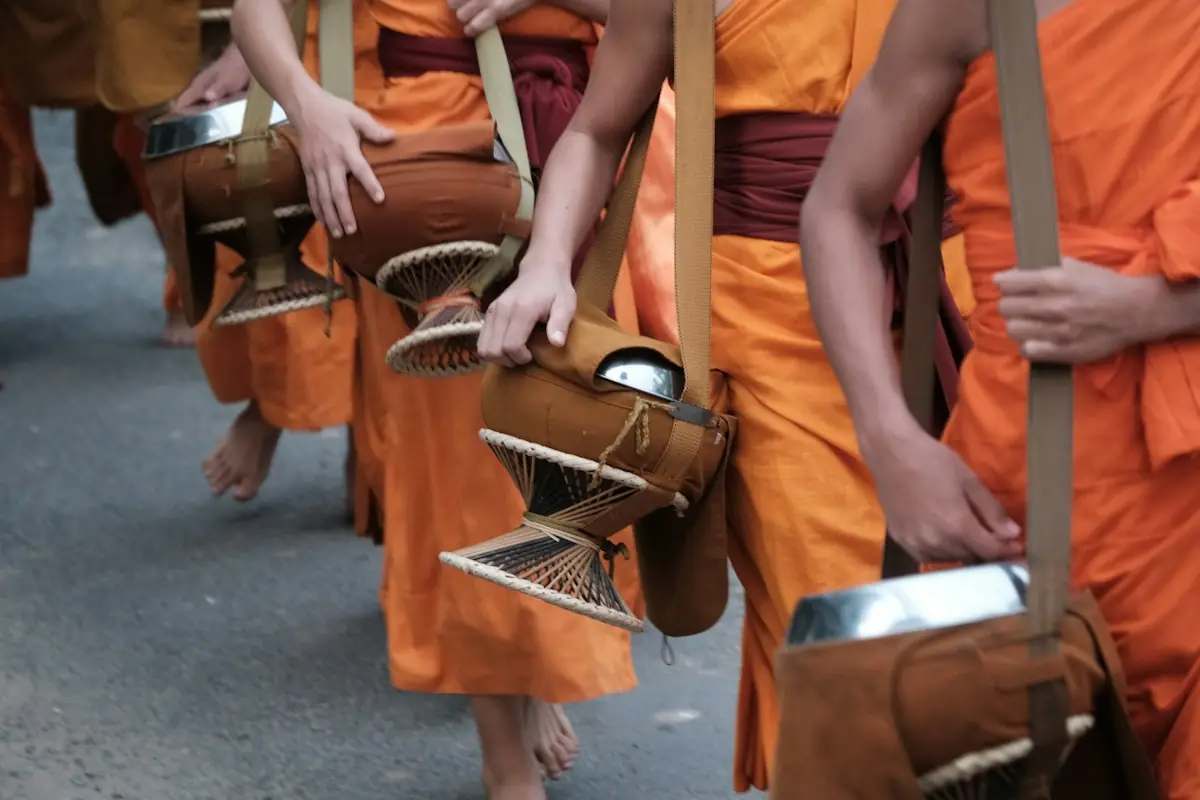
- Women must not touch monks. To pass something, place it in front of the monk or hand it over through a man.
- Monks get seats on transport and priority in queues, and airports and stations sometimes have seating reserved for them.
Wat Chalong: visiting Phuket’s main temple
Head, feet and the Thai wai greeting
The head is regarded as the most respected part of the body and the feet as the lowest. So you do not touch adults on the head or ruffle their hair, you do not point at anyone with your feet or rest them on a table or chair, and you do not step over people who are sitting down. The wai, palms pressed together near the face with a slight bow, is started by the younger or junior person. A visitor does not need to master the nuances: returning a wai is enough. You do not initiate a wai to waiters, shop staff or children; a smile and ‘khop khun kha’ (said by women) or ‘khop khun khrap’ (said by men), meaning thank you, will do.
Tone, face and appearance
Thai culture values the ability to save face, your own and other people’s. A raised voice, shouting and public irritation do not help here; they make you the losing side, the other person shuts down, and the problem gets harder to solve. Make a complaint at a hotel or restaurant calmly and with a smile, privately if possible. Appearance speaks for you too: swimwear and bare chests stay out of shops, cafés and town streets, and public nudity on the beach is an offence that is fined in Phuket. Keep hugging and kissing in public low-key.
Alcohol and Buddhist holy days
Since 29 May 2026 the afternoon ban on alcohol sales has been lifted: shops, 7-Eleven included, sell alcohol from 11:00 to midnight without a break. Bars, clubs and hotels operate under their own licences, often later. On the five main Buddhist holy days (Makha Bucha, Visakha Bucha, Asalha Bucha, Khao Phansa and Ok Phansa) sales are banned in shops and ordinary restaurants, and exemptions for hotels and tourist zones are confirmed separately each time. If a dinner falls on one of these days, ask the restaurant in advance.
Bargaining: where it fits and where it does not
- Bargaining is normal at night markets, with souvenir and clothing sellers, and with tuk-tuk drivers and boatmen, where the price is agreed before the ride.
- You do not bargain at 7-Eleven, shopping malls, pharmacies, street-food cooks, restaurants with menus or salons with a price list.
- Start below the asking price and meet in the middle, with a smile and no pressure. A difference of 20–50 baht is small change for you and a noticeable share of the seller’s earnings.
- Once you agree on a price, buy: backing out after a deal makes the seller lose face.
- If you cannot agree, say thank you and walk away. Sometimes the seller follows with a new offer.
Thailand laws and fines — what tourists should know
Frequently asked questions
Tipping in Thailand: how much should I leave at a restaurant?
If the bill already includes a 10% service charge, nothing extra is required. In cafés without one, people usually round up or leave 20–100 baht depending on the service.
Should I tip for a massage?
It is not required but customary: a guide figure is 50–100 baht per hour in an ordinary salon and 100–300 baht in an upmarket spa. Hand it to the therapist in person after the session.
What does ‘++’ mean on a restaurant menu?
A 10% service charge is added to the price and then 7% VAT, so the total comes to roughly 17.7% above the listed price.
How should a tourist behave in Thailand so as not to offend anyone?
Do not criticise or discuss the royal family, cover up in temples, do not touch people’s heads or point with your feet. Keep calm in any dispute: shouting works against you in Thailand.
Can a woman touch a monk?
No. Women do not touch monks or hand them anything directly: the item is placed in front of the monk or passed through a man.
Should I bargain in Thailand?
At markets, with souvenir sellers and with tuk-tuks, yes, it is normal. In shops, malls, restaurants and salons with a price list, prices are fixed.
You can book a massage, a tour or a restaurant table through the AURA catalogue: there is no platform fee for the client, the price is no higher than going to the partner directly, and tipping stays entirely up to you.